St Stephen’s CE Primary School
Core Subjects
Reading
At St Stephen’s we recognise that reading plays an important part of life and education. We believe that all pupils should be empowered to be fluent, confident readers who are able to successfully comprehend and understand a wide range of texts. We want pupils to develop a love of reading, a good knowledge of a range of authors, and be able to understand more about the world in which they live through the knowledge they gain from texts across a culturally diverse and varied curriculum.
Implementation
The Reading Programmes used to develop our readers:
EYFS:
Talking about texts/ sharing texts /bringing texts alive
Fully decodable Big Cat Collins Phonics books (matched to our Phonics programme.)
Phonics Programme: Little Wandle Letters & Sounds
KS1/ Year 1:
Daily Supported Reading Programme
Phonics Programme: Little Wandle Letters & Sounds
KS1/ Year 2:
Guided Reading Approach
Destination Reader Programme (reduced)
Phonics Programme: Little Wandle Letters & Sounds
KS2:
Destination Reader Programme
All:
Levelled Home Readers
Enrichment Activities
Engagement with authors, visiting the local library, involvement in national book events, visiting book fairs, school based competitions, the sharing of pupils’ reading journeys, refreshing books, creating and using audio books all help to keep reading fresh, pleasurable and alive within our school. Reading for pleasure sessions also are built into the timetable and children are always encouraged to read at home.
Parental Involvement
We understand the importance of parents and carers in supporting their children to develop both word reading and comprehension skills and encourage a home-school partnership which enables parents and carers to understand how to enhance the skills being taught in school through good quality texts.
Impact
By the end of their time at primary school, all children should be able to read fluently, and with confidence, in any subject in their forthcoming secondary education.
Pupils will enjoy reading across a range of genres
Pupils of all abilities will be able to succeed in all reading lessons
Pupils will use a range of strategies for decoding words, not solely relying on phonics
Pupils will have a good knowledge of a range of authors
Pupils will be ready to read in any subject in their forthcoming secondary education
Parents and carers will have a good understanding of how they can support reading and home, and contribute regularly to home-school records
The percentage of pupils working at age related expectations within each year group will be at least in line with national averages or above
The will be no significant gaps in the progress of different groups of pupils (e.g. disadvantaged vs non-disadvantaged)
We do not put ceilings on what pupils can achieve in reading and we do not hold pre-conceptions about any pupils’ ability to make progress.
Our Reading Programmes
- Daily Supported Reading - Reading in Year 1
- Destination Reader - Reading in Years 3 - 6
- Reading at St Stephen's PPT .pptx
Phonics at St Stephen's
We follow Little Wandle Letters and Sounds. The programme allows children to develop the foundational skills they need to become confident readers and writers, starting with Foundations for Phonics in the Nursery. As children move through school, there's a clear progression of skills, which builds upon what has been taught before. The programme also allows children ample opportunities to revisit previously taught skills, thus ensuring these are consolidated and remain secure, whilst children acquire new knowledge.
Little Wandle also offers additional support for children who might need it through Daily Keep-up, Rapid Catch-up and the SEND programme, ensuring that all children's needs are met and they can achieve their full potential.
If you would like more information on the programme, please follow this link: Little Wandle for Parents
Supporting Reading at Home
Writing
Our Intent
At St Stephen’s, we believe that all pupils should be able to confidently communicate their knowledge, ideas and emotions through their writing. We want our pupils to acquire a wide and varied vocabulary to empower their writing, have the ability to demonstrate a solid understanding of grammar and be able to spell new and less familiar words by effectively applying the spelling patterns and rules they learn. We want them to write clearly, accurately and coherently, adapting their language and style in and for a range of contexts, purposes and audiences. We believe that all pupils should be encouraged to take pride in the presentation of their writing, in part by developing a good, joined, handwriting style by the time they move to secondary school. We believe that all good writers refine and edit their writing over time, so we want children to develop independence in being able to identify their own areas for improvement in all pieces of writing, editing their work effectively during and after the writing process.
Implementation
We teach writing as whole class lessons, so that all children have access to the age-related skills and knowledge contained in the National Curriculum. We use strategies from Talk for Writing throughout the school, which involve the use of text maps, scaffolding, boxing up, short burst writing activities, writing toolkits and word banks. The writing process is modelled through carefully selected units of work and engaging cross-curricular topics.
Spellings: Spellings are taught according to the rules and words contained in Appendix 1 of the English National Curriculum. To support teaching, teachers are also guided by the No Nonsense Spelling Scheme which provides activities that link to the weekly spellings. Children are given spellings to learn each week and are given a spelling test the following week. In the lower school spelling is taught in groups according to ability and the differing needs of the children, which will also include the teaching of phonics.
Grammar and Punctuation: Grammar and punctuation knowledge and skills are taught through English lessons as much as possible. Teachers plan to teach the required skills through the genres of writing that they are teaching, linking it to the genre to make it more connected with the intended writing outcome. Teachers sometimes focus on particular grammar and punctuation skills as stand-alone lessons, if they feel that the class needs additional lessons in which to embed and develop their understanding or to consolidate skills.
Presentation: Handwriting is taught throughout the school; it is an integral part to any lesson and is reinforced daily. Class teachers and children follow a cursive handwriting scheme which acknowledges that handwriting is a developmental process.Children are expected to use joined, legible handwriting and work towards achieving their pen licence, where they can then write in black pen.
Impact
All children will enjoy writing across a range of genres, make links and apply their skills in cross-curricular topics. Children of all abilities will be able to succeed in all English lessons because work will be appropriately scaffolded. They will have developed a wide vocabulary that they are able to use within their writing and will have a good knowledge of how to adapt their writing based on the context and audience. Children will leave school being able to effectively apply the spelling rules and patterns they have been taught.
Mathematics Vision Statement
Intent:
In order to be a positive, confident individual in today’s world, our intent in mathematics is to empower children to develop a deep, secure, long-lasting understanding of all the concepts contained in the National Curriculum, and to be able to draw upon this understanding to making connections and solve problems. The skills developed within mathematics, should go beyond the individual subject and impact our children’s lives.
Within this, we intend for children to become confident using a range of mathematical skills including but not limited to the following:
Using a range of tools to calculate accurately both mentally and using formal operations
calculating using all four operations (including those involving money)
Calculating using fractions
understanding measurement in a range of contexts including telling the time, (including interpreting calendars, timetables etc)
interpreting and presenting information in tables, graphs and many, many more.
It is our intent to ensure that children develop many key skills to empower them to face life’s challenges and thrive in their lives, providing them with the best opportunities to reach their full potential.
|
|
|
|
Implementation:
We use the White Rose Scheme (broadly but not solely) as a basis for learning as it provides:
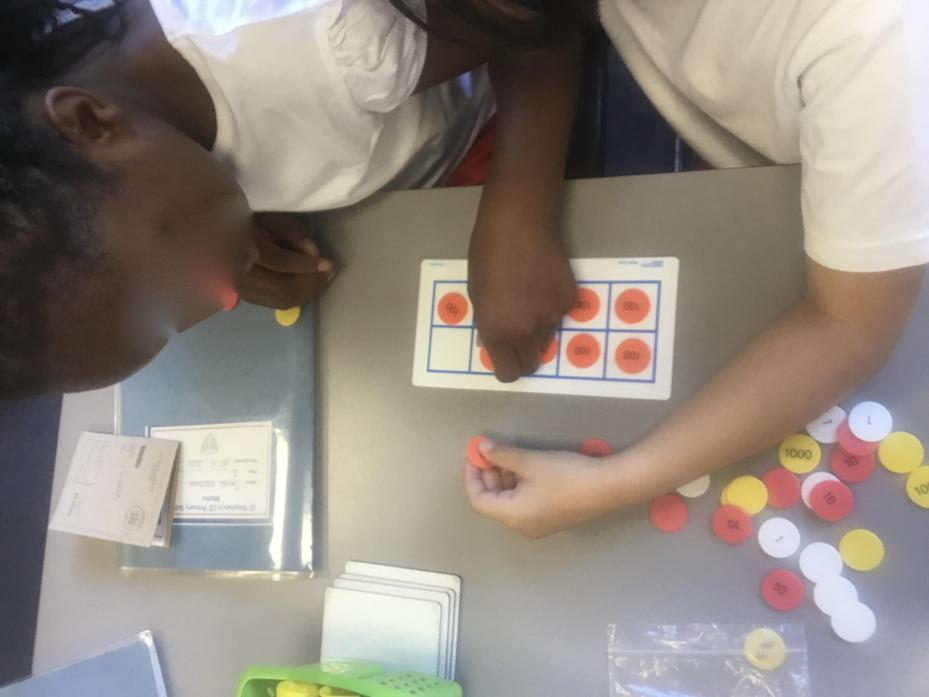
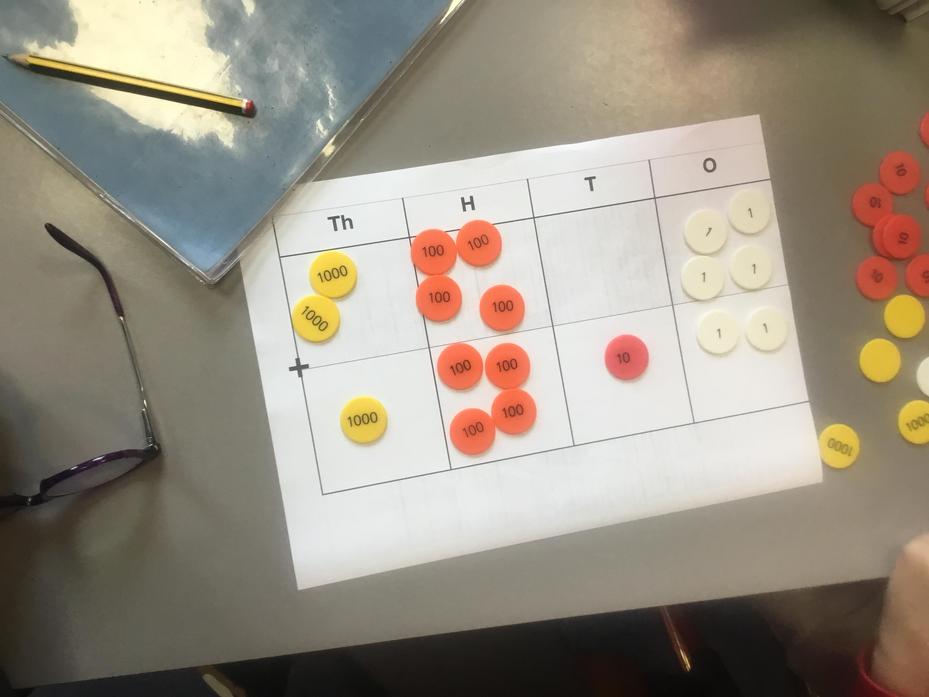
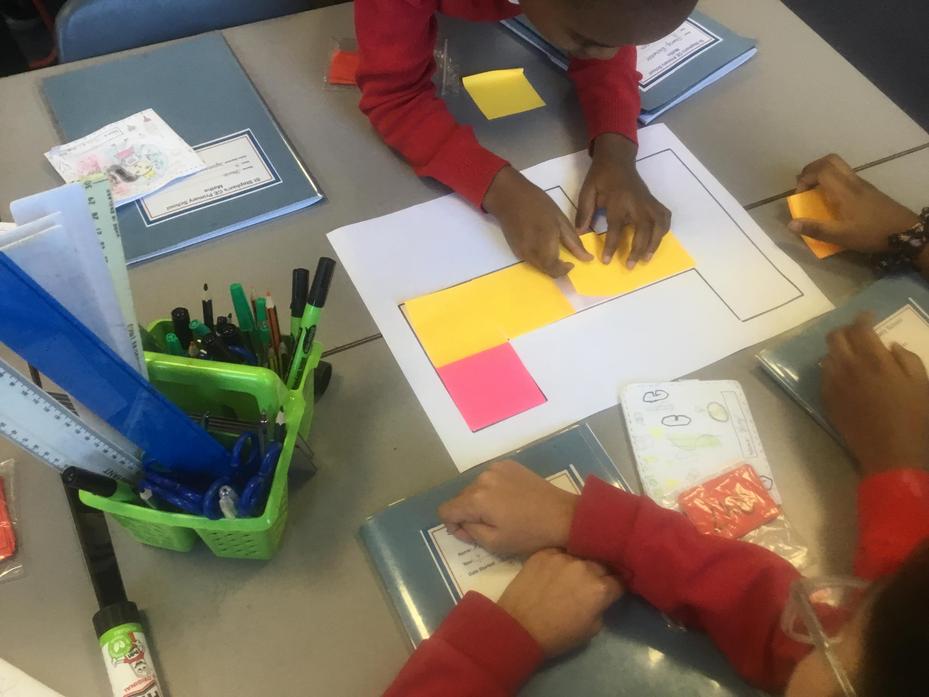
Powerful CPA (Concrete and pictorial approaches, before abstract) in order to provide deep and meaningful learning. These include much researched approaches used in Singapore including the bar model, part-whole models and more.
Emphasis on mathematical language, reasoning and problem solving
Combines ‘mastery’ and ‘spiral approaches’, including spending longer on topics to deepen and broaden understanding, along with revisiting and reinforcing concepts year on year.
It is ambitious for all - providing support and challenge where required.
Mathematics Curriculum at st stephens
Teachers are guided by the White Rose Maths Primary Scheme of Learning. The reasons for using this scheme and the White Rose resources are outlined below. We believe however, that the best teachers find nuggets from a wide range of sources. Therefore, we don’t rely entirely on one scheme or resource. For example, using video demonstrations, lessons, ideas and resources from the internet or other published sources that support children’s learning.
The St Stephen’s Calculation Policy is also a vital tool in teacher’s planning. It has been developed to ensure that children learn calculation concepts through the solid foundations of concrete and pictoral approaches, before abstract methods are introduced. A whole school approach ensures there is consistency in practice. See link below.
The St Stephen’s Calculations Policy
The White Rose Scheme of Learning
https://whiterosemaths.com/resources/schemes-of-learning/primary-sols/
Please see our sections for The White Rose Scheme by Year group
Why White Rose?
The reasons we chose the White Rose Maths Primary Scheme of Learning can be summarised by the following points:
It provides a powerful CPA approach (concrete, pictoral, then abstract) including in its use of models and images, which helps secure pupils understanding of mathematics and to make connections between different representations.
There is a great emphasis on mathematical language, questioning, explaining, reasoning and problem solving. This allows pupils to discuss the mathematics they are doing, support each other to take ideas further, and develop a broad and secure understanding.
It provides a connected, progressive curriculum, aiding the development of carefully sequenced lessons, (See more below on progression within the scheme).
It develops the skills of teachers, without interfering with professional judgement by being over prescriptive.
The curriculum is designed to use skills that have already been learnt in different contexts (sometimes called ‘interleaving’) whenever possible. This helps pupils to remember and to make connections between different parts of the curriculum.
It combines the best of both ‘mastery’ and ‘spiral’ approaches in the curriculum. It follows many of the mastery principles – spending longer on topics to help gain deeper understanding, making connections, keeping the class working together on the same topic and a fundamental belief that, through effort, all pupils are capable of understanding, doing and improving at mathematics. But also recognising that just spending a good chunk of time on a topic doesn’t mean that all pupils will ‘master’ it the first time they see it, and that they need to see it again and again in different contexts and in different years to help them truly develop their understanding on their journey to mastery, so we’ve built in the revisiting and reinforcing features of spiral curricula too.
It is a curriculum that is ambitious and that works for all, with everybody studying the same topic and being provided with support and challenge as needed. Many of the teaching strategies we advocate for all pupils are particularly useful for pupils with SEND. See more on how the scheme supports those with SEND below
Progression
Supporting Pupils with SEND
Curriculum Summary by Year Group
- key_learning_in_mathematics_-_year_1.pdf
- key_learning_in_mathematics_-_year_2.pdf
- key_learning_in_mathematics_-_year_3.pdf
- key_learning_in_mathematics_-_year_4.pdf
- key_learning_in_mathematics_-_year_5.pdf
- key_learning_in_mathematics_-_year_6.pdf
Paper and Pencil Methods at St Stephens
Timestable - What gets learnt
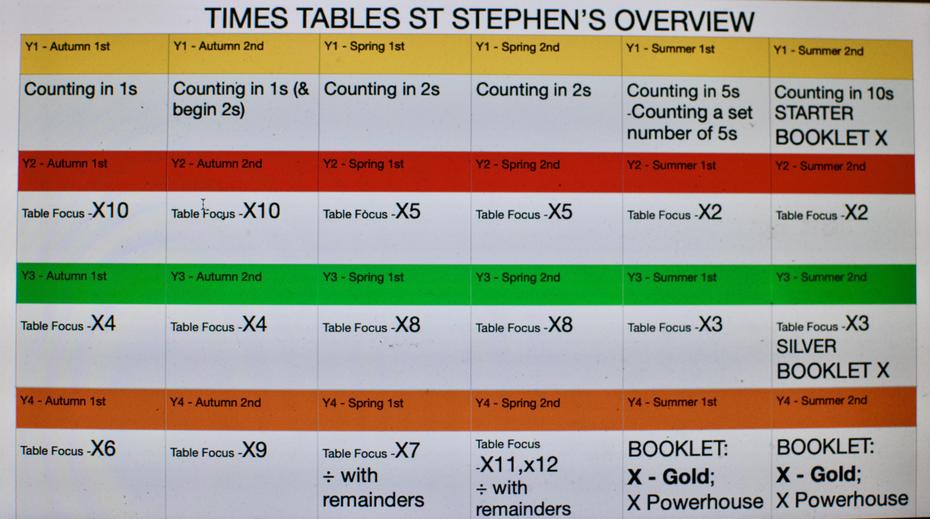
Times Tables v2 Mental Maths Structure MARCH 2022.pdf
Please see our sections for Times Table Poster Support
How we teach times tables at St Stephens
The key ways in which we learn times tables at St Stephens are:
- Considering which facts the children already know (from other times tables they have learnt)
- Searching for patterns
- Using a counting stick. (with strategies such as doubling and halving) See video by Jill Mansergh.
- Learning through times table songs or chanting the facts (including the use of different voices or the musical elements e.g. forte)
- Revising using the help cards/posters
We also use a range of representations, including real life examples, so this concept isn't abstract.
Teaching Strategy in practise
How we develop speed and accuracy
Children develop this through the following key ways:
- Times Table Rock Stars (see tutorials below)
- Card games
- Class practise including head to head games.
Times Table Card Packs Introduction
Place cards face down on a table. (Alternatively an adult might hold them up in turn for a child to answer). Correct answers can be placed in one pile. Calculations the children struggled with can go on another pile. This helps to identify a limited number of facts to be focussed on.
The card packs can be used to track speed and accuracy. Record their initial speed and accuracy. After a period of practise, retest them to see how much they have improved.
Times Table Card Pack Practise.mov
Times Table Card Packs
If you would like to request a card pack to enable your child to practise at home, then either ask at the office, email, or speak to your child's class teacher.
Times Table Rockstars (TTRS)
Game Types on TT Rock Stars (Feb 2021)
Includes Gig, Garage, Jamming, Studio, Soundcheck, Festival, Arena and Rockslam.Read about the different game types here: https://intercom.help/times-tables-...
Monitoring Your Child's Progress in Times Tables (on TTRS)
Times Table Booklets & Awards Introduction
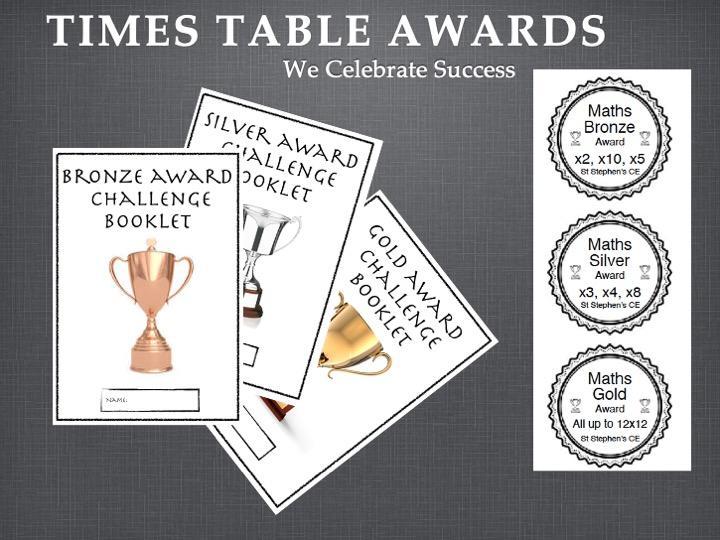
Please see our sections for Fun Videos & Supplementary Activities for learning times table facts
Science
Science at St Stephen's
Rooted Empowered Serve
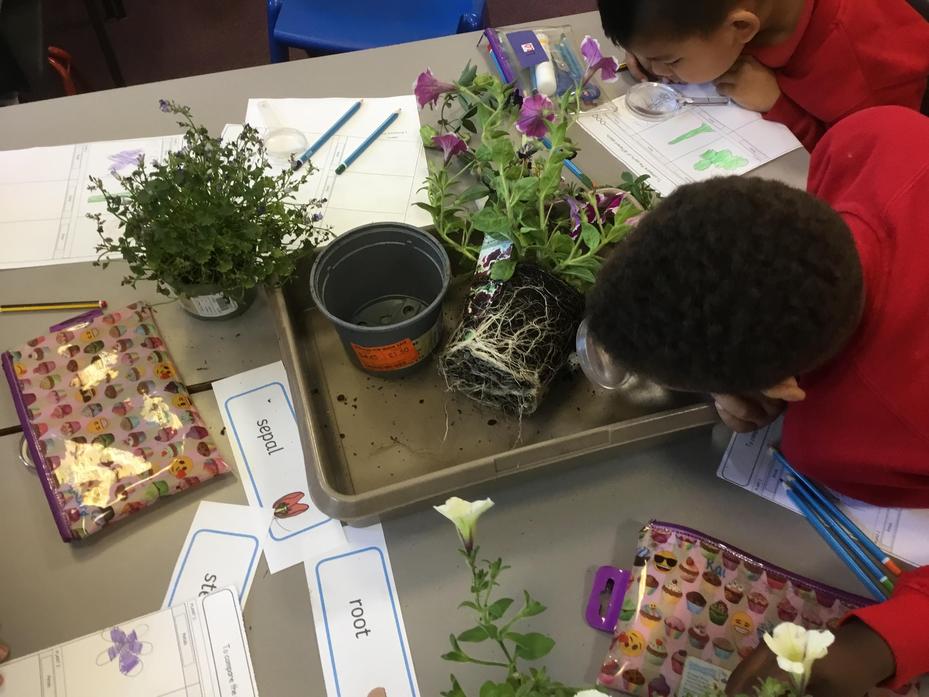
At St Stephen's we believe a high-quality Science education provides foundations for understanding the world. It develops an understanding of scientific ideas and makes links between phenomena and experiences. It stimulates a child’s curiosity and It teaches methods of enquiry and investigation. Children learn to ask scientific questions and begin to appreciate the way Science will affect their future on a personal, national, and global level.
Our Intent
We teach science at St Stephen’s to
- Develop scientific knowledge
- Nurture curiosity about how and why things work
- Ask questions and develop skills to answer questions
- Form a decision based on evidence
Implementation
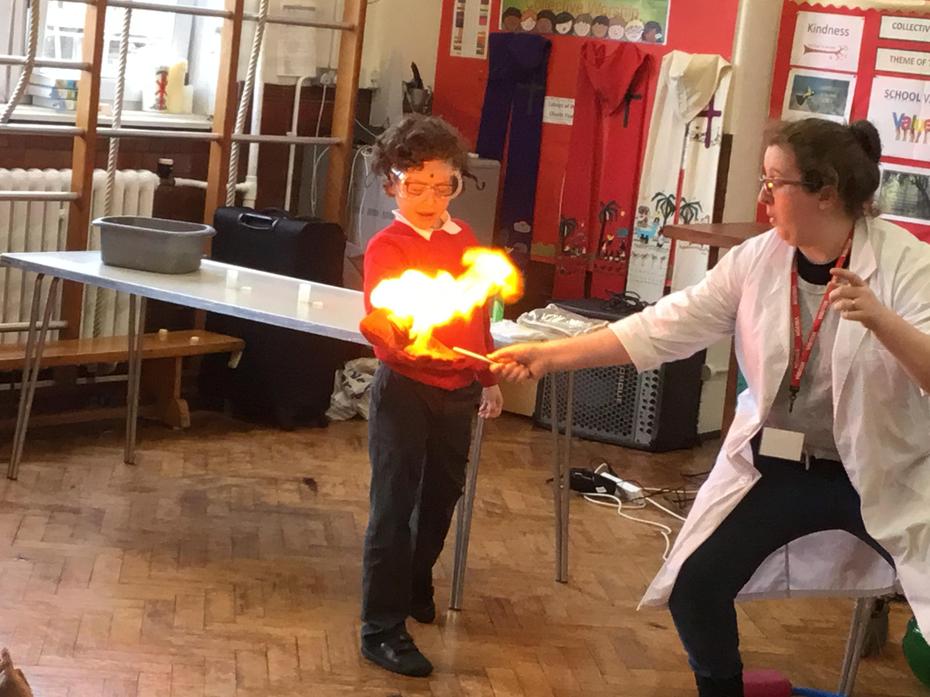
- Using a curriculum based on an extensive variety of practical activities, from observational to investigations. Using Snap Science as a starting point.
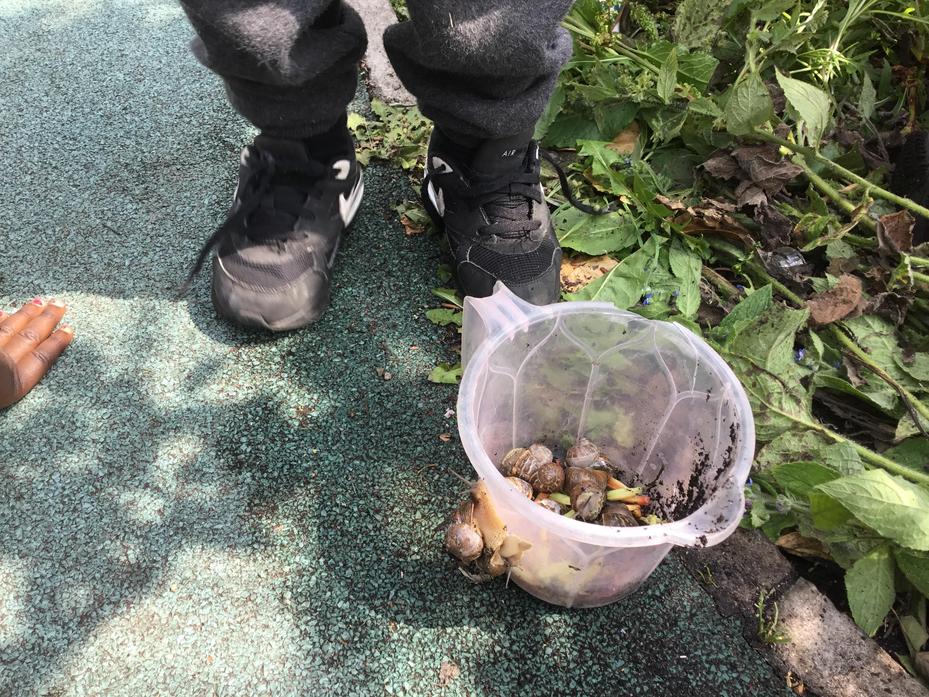
- Taking advantage of the benefits of ‘outdoor learning’ opportunities with our new forest school scheme, visiting Brookmill Conservation park and the local allotment to learn about variations in plants, minibeasts and habitats .
- Beginning each topic with an interesting stimulus (hook) to raise curiosity and raise questions about the topic, knowledge harvest, topic explanation and assessment of knowledge.
- Science curriculum overview Years 1 to 6.docx
- Science Progression document for years 1 to 6.docx
- EYFS curriculum-overview learning-about-the-world.pdf
Impact
By the end of their time at primary school, all children should be able to encounter more abstract ideas and begin to recognise how these ideas help them to understand and predict how the world operates.
- They should also begin to recognise that scientific ideas change and develop over time.
- They should select the most appropriate ways to answer science questions using different types of scientific enquiry, including observing changes over different periods of time, noticing patterns, grouping and classifying things, carrying out comparative and4 fair tests and finding things out using a wide range of secondary sources of information.
- Pupils should draw conclusions based on their data and observations, use evidence to justify their ideas, and use their scientific knowledge and understanding to explain their findings.

|
|
|
|
|
|
|
Fun with upthrust.mp4
National Geographic Kids