

St Stephen’s CE Primary School
Mathematics
Mathematics Curriculum Vision Statement
Intent
At St Stephen's C of E Primary School, we are committed to providing high-quality maths education that nurtures confident, resilient and articulate learners. We aim to ensure every child develops a deep conceptual understanding of maths, recognising it as a purposeful and essential part of everyday life. Our curriculum is carefully sequenced to build knowledge and skills progressively from Reception to Year 6. In EYFS and Key Stage 1, we use the Maths Mastery programme to secure foundational number sense. In Key Stage 2, we draw upon White Rose Maths and bespoke high-quality resources to ensure full National Curriculum coverage tailored to our pupils. Driven by a mastery approach with high expectations for all, we adapt our provision to ensure that every child, including those with SEND, gains the essential fluency, reasoning, and problem-solving skills needed to thrive.
Implementation
Our mathematics curriculum develops pupils' expertise across the core domains of the National Curriculum:
-
Number & Place Value
-
Addition, Subtraction, Multiplication & Division
-
Fractions, Decimals & Percentages
-
Measurement
-
Geometry (Properties of Shapes, Position & Direction)
-
Statistics
-
Algebra (Upper Key Stage 2)
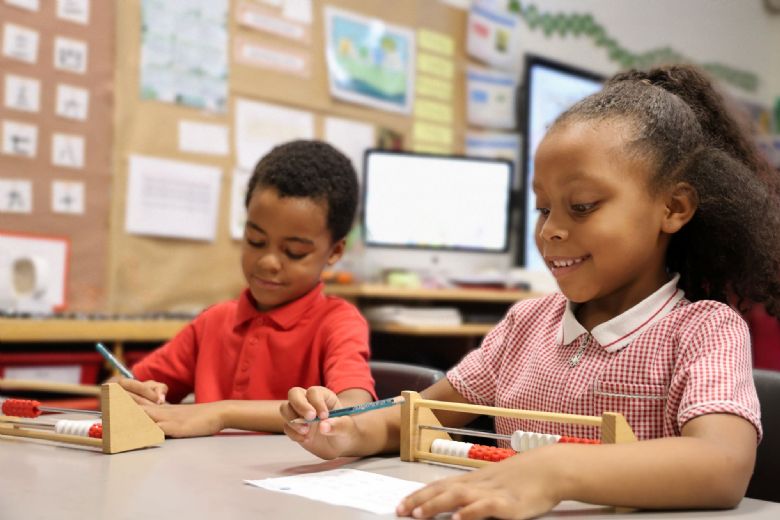
Teaching follows a concrete, pictorial, and abstract (CPA) approach, using physical manipulatives, visual models and structured mathematical talk to make abstract concepts accessible and secure. Rapid recall and procedural fluency are developed systematically: pupils use NumBots and Times Tables Rock Stars alongside our dedicated 'Arithmetic Friday' sessions and weekly arithmetic tests. Mathematical reasoning and problem solving are embedded daily, with explicit teacher modelling and scaffolding supporting accuracy and depth of understanding. Maths is actively applied across the wider curriculum in science, geography, computing and DT, for example, through data collection, measurement and recording. Continuous formative assessment, retrieval practice and low-stakes checks allow teachers to address misconceptions instantly, while targeted support and rich variation provide challenge for all learners.
Impact
By the end of Year 6, pupils leave St Stephen's as articulate, confident and independent mathematicians who are well prepared for secondary education and beyond.
Our pupils will:
-
Develop strong fluency, procedural accuracy, rapid recall in mental and written calculations.
-
Reason logically and explain their mathematical thinking using precise mathematical vocabulary.
-
Solve complex problems efficiently by selecting and applying appropriate strategies.
-
Apply mathematical knowledge confidently across the wider curriculum and in practical, real-world situations.
-
Approach mathematical challenge and unfamiliar contexts with resilience and confidence.
Ongoing formative assessment, end-of-unit checks and termly summative evaluations demonstrate sustained progress and high standards across the school. Through continuous monitoring, including book looks, lesson visits, pupil voice and collaborative moderations, subject leaders ensure consistent progression, robust subject knowledge and good outcomes for every child
Times Table Fluency

At St Stephen's C of E Primary School, we believe that rapid recall of number bonds, multiplication and division facts is essential for developing confidence and success in mathematics.
As pupils move through the school, they encounter increasingly challenging concepts such as fractions, decimals, percentages, long multiplication and long division. Secure times table knowledge allows children to focus on reasoning and problem solving rather than working out basic number facts.
To develop mathematical fluency, we use a range of approaches throughout the school, including:
-
Daily arithmetic first 15 (from 9:00- 9:15).
-
Weekly Arithmetic tests (Fridays) and whole class teaching.
-
In class learning on mental strategies for all operations.
-
Interventions for those that need extra support.
We also support this using:
-
NumBots (from Year 1)
-
Times Tables Rock Stars (from Year 1)
Milestones
By the end of each year group, children should be confident in the following mental maths targets.
Number bonds: the possibilities of adding and subtracting up to that number, e.g. number bonds to 5 means knowing all the ways to +/- to make 1, 2, 3, 4, 5.
Times tables: Rapid recall of times tables facts, including division at random, e.g. 7 x table means knowing all the facts up to 12 x 7 and all the corresponding division facts.
|
Number bonds |
Times tables |
|
|
Reception |
To 5 |
Doubles to 10 |
|
Year 1 |
To 10 |
Doubles to 20 Counting in 2, 5, 10 |
|
Year 2 |
To 20 |
X 2, x 5, x 10 Counting in 3s |
|
Year 3 |
To 50 |
X 3, X 4, X8, X 6 |
|
Year 4 |
To 100 |
X 7 x 9, x 11, x 12 ( MTC check on all Times tables) |
|
Year 5 |
Decimal bonds to make 1 |
X÷10/100/100 Division with remainders |
|
Year 6 |
Decimal bonds to make 10 |
Fractions, decimals and percentages equivalents |
How You Can Help at Home
Parents and carers play an important role in developing mathematical fluency. You can support your child by:
-
Practising multiplication and division facts regularly.
-
Encouraging regular use of NumBots and Times Tables Rock Stars.
-
Completing any arithmetic or multiplication practice sent home by school.
-
Revisiting any facts your child finds challenging until they can recall them confidently.